Potato Onion Resurrection
The Breeding Methodology
When undertaking a project it is always useful to develop a method of work – in other words, come up with a series of steps which will, hopefully, advance you towards the desired result.
Before we discuss that, let’s take a step back and look at a broad overview of the problem. What is it that we really want from a Potato Onion breeding program? Also, very importantly, what are the constraints that will have to be dealt with?
The Goal
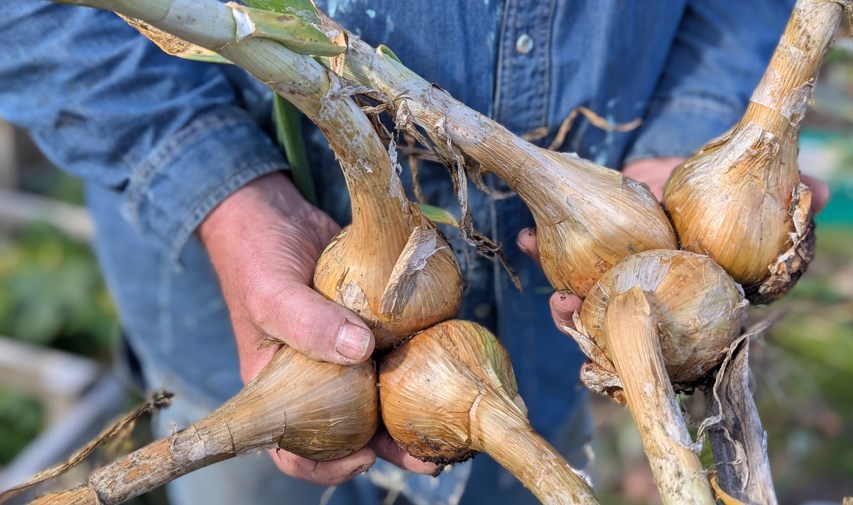
The ideal outcome is an onion that, when planted as a bulb, splits into a clump of multiple other bulbs by the end of the growing season. Each of those bulbs should also reach a suitable size. Bulbs broken off from the clump at the end of a growing season and re-planted should again individually produce a similar clump by the end of the next. This process should be repeatable indefinitely. It is also a requirement (of mine) that such onions must readily produce viable seed.
The Constraints
If you wish to breed onions (or any plant) you need to be able to cross individuals with desirable traits together and then produce seed from them - the offspring of which can then be selected, culled and further propagated.
Most existing Potato Onions have a problem with that. In theory they should set seed and, because they do not die, they should continue to set seed every year. However, many centuries of vegetative propagation seem to have considerably inhibited the ability of the existing heirloom varieties to produce viable seed heads.
On the other side of the coin, we also have a diverse array of modern onions which are completely biennial. This means they grow from seed in the first year, readily set seed in the second and then die.
Looking at it logically, the steps toward achieving the goal resolve down to either:
somehow obtaining existing heirloom Potato Onion varieties, coaxing them to reliably set seed and then selectively breeding from them.
– or –
somehow convince modern biennial onions to give up being biennial, begin splitting into clumps, effectively become perennial and then selectively breed from them.
The Beginnings
In the early days of the project I concentrated on option 1 and tried to get existing Potato Onions to reliably set seed. Most of the surviving heirloom Potato Onion varieties seem to be located in the USA and, since I am in the UK, phytosanitary regulations prevented me from importing bulbs. I did obtain some seed but my results, year after year, were unsatisfactory. The resulting onions were small and, although some did split and occasionally set seed, the results were not at all impressive and were quite hard to work with.
After some years of this, a change of tactics was clearly necessary. I had heard, that in the distant past, all onions were effectively Potato Onions and the biennial-ness of the modern onions we have today is a fairly recent “innovation” carefully bred in with the intention of making them larger and easier to harvest via mechanical means. If true, my reasoning went, if modern onions were truly the descendants of various regional Potato Onion varieties it could well be that many of them still have Potato Onion genes buried deep within them just waiting to be let out.
I had previously noticed that crossing various modern onion varieties together tended to unlock hidden characteristics. In effect, mongrelizing them tended to revert the resulting offspring towards more primal types.
So I folded the results of the previous Potato Onion breeding efforts into a new methodology in which I maintained a Base Group of onions and just let them randomly cross with any modern onion variety I could get my hands on.
In effect, I was just throwing genes at the problem using the Joseph Lofthouse Promiscuous Pollination technique. Of course, adding genes is only half of the solution – the other half is selection and culling. For years, I would carefully plant out the onions, save the seed, select any onions that looked kind of splitty or clumpy for the Base Group, remove the weakest and then repeat the process in the next season.
The effect of continuous selection pressure is truly an amazing thing to observe. For quite a long time the results were modest at best. Then, one season (2023), things seemed to “catch” and an increasing number of the onions in the Base Group began to form recognisable clumps. All would readily set seed - my selection for that trait was particularly strict. The Base Group of onions could now form a start point for a Potato Onion breeding program. Due to the continuous random addition of genes, the onions in the Base Group were improbably diverse.
When selecting for the Base Group, no attempt was made to collate onions from specific clumps and keep them separate. In other words, if an onion split into two (or rarely three) all of the bulbs were just added back into the Base Group. This had the interesting effect of increasing the percentage of the genes of that variety in the resulting seed stock and thus gently biasing the gene pool in that direction.
Eventually it became clear that I had a diverse Base Group providing reasonable Potato Onions that also set seed. I suppose, at this point, I could have just started to pluck specific clumps from the group and specifically propagate them vegetatively as individual lines. However, there are quality control issues. Just because an onion had split in its second year there is no guarantee that it would continue to split in the future. Before releasing a “named line” of Potato Onion I needed to confirm that the onion would, at minimum, split again in the third year and also produce consistent results.
Clearly, the “Base Group” methodology, having got the project to the starting gate, needed to be refined in order to move forward.
So here is what I have come up with….
- In the first year the onions are planted with seed taken randomly from the Base Group onions which flowered the previous year. These seeds typically grow into a diverse collection of onions. Some even produce remarkably large bulbs – but none have ever been observed to split in the first year. In the first year, regardless of the genes they carry, all the onions seem to want to do is produce one single bulb. The weaker onions are removed at the single bulb stage. At the end of the growing season I refer to these as Category 1 onions.
- In the following spring the Category 1 bulbs are all planted out together. At this point I am primarily interested in seeing which bulbs are going to split. I don’t record definitive data but, anecdotally, about 75% of the Category 1 bulbs will split in the second year. The single bulb onions which do not split and the ones that do not set seed are culled from the group. Most of the bulbs will just split into two, however, a gratifyingly large percentage (maybe 20% or so) of the bulbs will split into triples and quads – sometimes even higher. Previously, I had named these the Category 2 onions and just split them up and threw them back into the Base Group at the end of the season. In the new methodology I call them a “Cohort” and keep them separate from the Base Group. The formal Cohort name also contains the year in which the bulbs made it through the second year cull. In other words, there are now separate groups like Cohort 25 and Cohort 26 etc.
- In the third spring all active Cohorts get planted out into their own individual bed. During the harvest in the previous year, the clumps that looked particularly interesting were placed in individual mesh bags. They were still stored with their Cohort but the separation ensures that the genetically identical onions in each clump remain together. The bulbs in each interesting clump are planted out together and labelled. The bulbs which were not sufficiently interesting are just split up and randomly planted out. At the end of the season, all onions which did not split or which did not set seed are again culled.
By the end of the season the onions in some of the previously identified “interesting clumps” will, hopefully, have formed new clumps of their own. If the resulting clumps are consistent, each clump flowered and the onions continue to look interesting, they might be selected to form a “named line”. At this point I consider that line to be suitable for beta release to interested parties for further propagation and testing. The onions in a named line will have all been observed to split for at least two years in a row, produce consistent results from every bulb, set seed and also, not least, produce worthwhile onions.
After the third year, one onion from each interesting clump of each growing Cohort gets added back into the Base Group so as to improve that gene pool. I also continue to add in interesting modern biennial onions into the Base Group in order to keep the pool diverse. Note that not all onions in a Cohort make it back into the Base Group – just the interesting ones. This addition continuously biases the Base Group characteristics in directions I think might be useful.
As the years progress, it is not possible to keep an infinite number of Cohorts operational. So, at the end of a Cohorts third year, I will typically just take all the onions in it which were not selected for a named line (the vast majority) and mix them with previous years into a kind of “Grand Cohort”. This is a kind of melting pot of Potato Onions that gets planted out every year and furnishes me with the onions I eat. Needless to say, any onion that does not split and does not try to set seed does not get to stay.
Interestingly, the growth pattern of the Potato Onions in the Cohorts is unusual. Most of the onions, when you plant them as a bulb, split into multiple other bulbs indistinguishable from the original. In other words, you do not get a bunch of new onions surrounding a tired out old original onion. What you usually get is a clump of onions identical to the original and you cannot really see where the original one went. This behaviour is also observable when they set seed. You typically do not get some new onions and a bag of goo where the original bulb set seed.
The setting of seed does not seem to impact the onions tendency to split. Indeed, the onions which intend to split are rather obviously going to do this very early in the growing season – well before any scapes begin to form. Unless the onions are actually intended for seed (i.e.they are part of the Base Group) I usually just snip off the scapes as they appear and this does not seem to affect the size of the resulting onions. I do require them to set seed though and any that do not even try get culled. This is done to ensure that the Potato Onions are always prolific setters of seed – never again am I going to put myself in a position where I have to coax onions to set seed. As mentioned previously, the setting of seed does not seem to cause much in the way of repercussions on the growth of the bulb.
The bulbs in the Base Group are the seed source. They are typically planted in a greenhouse and allowed run to seed there. There are several reasons for this. The growing season in my region is usually too short for outdoor alliums to fully ripen their seed and growing them in a greenhouse extends the season sufficiently. The other reason is isolation. I really don’t want the Base Group randomly crossing in with other onions in my area – especially my neighbour’s decorative alliums.
The Base Group also provides bulbs as well as seed. As mentioned previously – the Potato Onions mostly no longer die when they set seed so they can be carried forward (with judicious additions from the Cohorts and other onions) into future years.
I should probably further clarify the difference between the Base Group and the “Grand Cohort”. The Base Group provides seed and is a reservoir of continuously updated genes – not all of which will result in worthwhile Potato Onions. The Grand Cohort consists of the un-culled remnants of older Cohorts which have fallen off the end of the third year cliff. As such, those Potato Onions have been through a fairly rigorous winnowing process. They are useful as a vegetatively reproducing crop but the diversity is much narrower – a thing I do not particularly value. I find it much more useful to maintain a light touch and gently bias my breeding stock towards a goal rather than forcing it there. The Grand Cohort just provides my “food” – they split every year, I eat some and plant the rest back.
Summary
So, with the current breeding methodology, in any one season there is:
- A bed of Category 1 onions growing from seed.
- A bed of Category 2 onions growing from bulbs which form a Cohort and which are the remnants of the previous year’s Category 1 onion cull..
- A bed with a Cohort of Category 3 onions which are the remnants of the previous year’s Category 2 Cohort cull.
- A bed of Named Lines of onions growing separately in order to make increase and for further testing.
- A bed with the Grand Cohort which is basically a dumping ground for the accumulated previous years Category 3 Cohorts.
- A bed in a greenhouse with the Base Group which is full of diversity and the seed of which produces very splitty, clumpy Potato Onions.
It has taken a while but I think the Potato Onion Resurrection project is now showing considerable promise. The seed stock is diverse, all of the onions prolifically set seed and a defined method of work is now producing Named Lines of Potato Onions.
If I look back to the early days, I would have been overjoyed to see any of the two and three onion clumps I now consider to be insufficiently interesting to bother with. Truly, I am spoiled for choice – which is a nice position to be in.
All of the results of this project are open source.